



Melsted harbour
An idyllic spot on the map with a history all its own
Historical Background
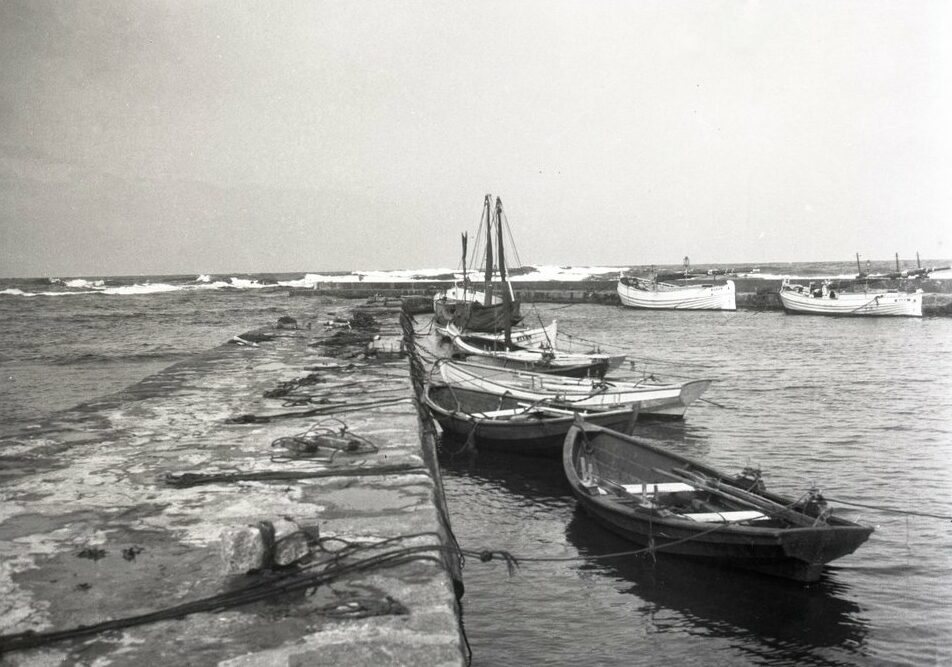
In 1883, 26 fishermen from Melsted applied to the Ministry of the Interior for a grant from the estate councillor Kofoed’s legacy to improve the harbour conditions.
In this application, the existing “harbour” is described as a breakwater “220 feet long, 10 feet wide and 3–4 feet high”.
The letter also contains a drawing by harbour engineer H. Zahrtmann showing a northern breakwater in relation to the existing one. The estimated cost was DKK 3,350.
The breakwater, which had no protective wall, i.e. no wave screen, was built of split stone and jointed with cement mortar – reportedly by Swedish stonemasons.
Following a renewed application to the Ministry of the Interior, the southern breakwater was renovated in 1888, and at the same time a 10-metre-long wave screen, 60 cm high, was constructed.
At the end of the 19th century, the fishing industry began using larger decked boats, among other things for salmon fishing, creating a need for deeper harbours. The harbour commission therefore applied for a government loan in 1898 to improve the harbour. The application was rejected, but under the Finance Act of 1909–10, DKK 6,500 was allocated to Melsted Harbour on the condition that the fishermen themselves raised the same amount.
This was achieved in 1910 through a loan from the savings bank and through the estate councillor Kofoed’s legacy, and the harbour was subsequently improved in 1912–14.
From 1914 until 1984, the harbour commission ensured the improvements and maintenance required to keep the harbour up to date.
TH. Poul Kofoed wrote the book “Melsted havn gennem 100 år 1884–1984”, published by the Melsted Harbour Board. The book can be purchased at Gudhjem Museum.
You can find many more photographs from Melsted Harbour in our digital photo archive.