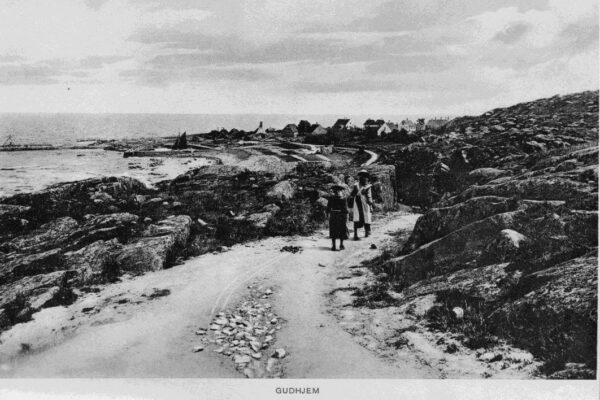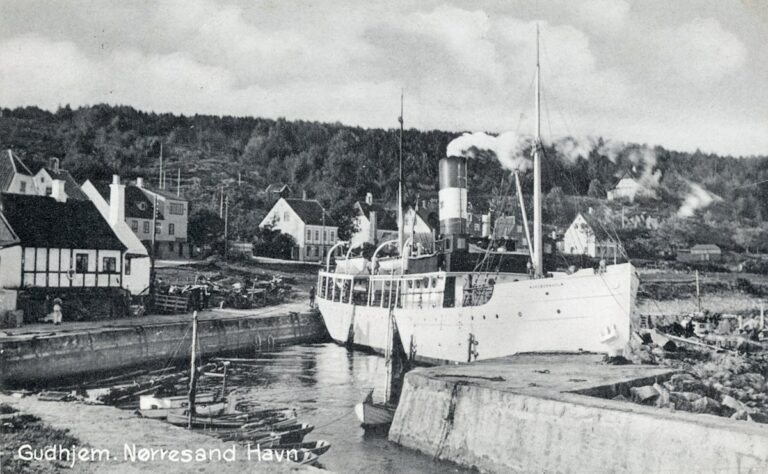
The need for a harbour in the northern part of Gudhjem arose as Løkkegade was established.
 There used to be a “løkke” here (a Bornholm word for an enclosed field) belonging to the fisherman Søren Christensen. It was therefore called “Sørensa Løkja” (Søren’s Løkke). He lived in the yellow half-timbered house that is today Ejnar Mikkelsensvej 2.
Around 1880, the Løkke was sold to the merchant Hans Madsen Schou and his brother-in-law, steamship agent Jens Larsen Jensen, who divided it into building plots.
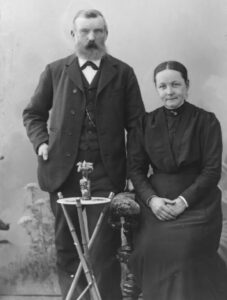
The merchant and lime burner Hans Madsen Schou (1846–1930) and his wife, Agnethe Marie Sofie, lived at Brøddegade 30.
The first two plots were sold immediately, and two houses were built at opposite ends of what is now Løkkegade.
One belonged to bricklayer Hans Lund at the southern end and the other to baker Ole Jensen at the northern end, now the Oluf Høst Museum, 100 metres from “Norresân hamn”.
Over the following decade, most of the Løkke, and thus Løkkegade, was built up.
At Nørresand there was already a small landing place with stones and gravel, used by older fishermen. They had small rowing boats which they used to row out to “Saleneknæet” to fish with nets. With the large influx of residents to Løkkegade, the need for a proper harbour grew steadily.
At the same time, a new harbour could serve as a reserve or emergency harbour for Gudhjem Harbour, where the East Bornholm steamships had been able to dock since 1877 when strong easterly winds made conditions difficult.
East of Nørresand was the offshore bedrock known as “Ræveskæret” (actually a rocky reef), which already provided a breakwater against northerly and especially easterly winds.
Following persistent efforts by the harbour board of Gudhjem Harbour, it became possible to obtain a government loan to begin construction of “Norresân-hamn”.
Carpenter Viggo Pedersen recalls:
“In March 1898, work began under the direction of harbour engineer Hans Zahrtmann of Rønne. (Hans Zahrtmann, a harbour engineer involved in many of Bornholm’s harbour construction projects, was the brother of the painter Kristian Zahrtmann.)
A dam was built, the water was pumped out and the harbour basin was blasted out of the rock – all by hand. When the rock had to be blasted, three men worked at each drill. One held the drill while two men, each with a hammer, stood on the drill and struck it so that it sank into the rock. Once the desired depth had been reached, the hole was filled with an explosive charge and fuse. The blasting was always carried out at the end of working hours, at midday or in the evening, so that all the men were away from the work site.
At first, the blasted stones were removed by wheelbarrow along a wooden bridge. But as this required a great many workers, rails and wagons were acquired, together with a locomotive borrowed from a threshing company in the countryside to pull the wagons uphill – and downhill they ran by themselves!
The stretch from the harbour to the schoolteacher’s bathing hut had previously been a flat beach with fortifications below the gardens, where houses now stand.
The harbour board obtained permission from Bornholms Museum to remove the fortifications on condition that a road was built to a piece of land on the other side of Suserenden, where a battery could be constructed to defend against foreign warships entering the harbour.
The road was built, and rocks were blasted at Styrtebakken (“Stortana”). The stones were used to build the breakwater at Norresân. The battery, however, was never built.
The flat beach was filled with material blasted from the harbour basin and used as net-drying grounds.”
The new harbour area was transferred by the harbour board to the harbour as property and leased to the fishermen as net-drying grounds, for their herring nets and as a working area.
In 1902, the new harbour, “Norresân hamn”, was completed. As early as 1918, the harbour was deepened so that the new steamships of Det Østbornholmske Dampskibsselskab could also dock.”