



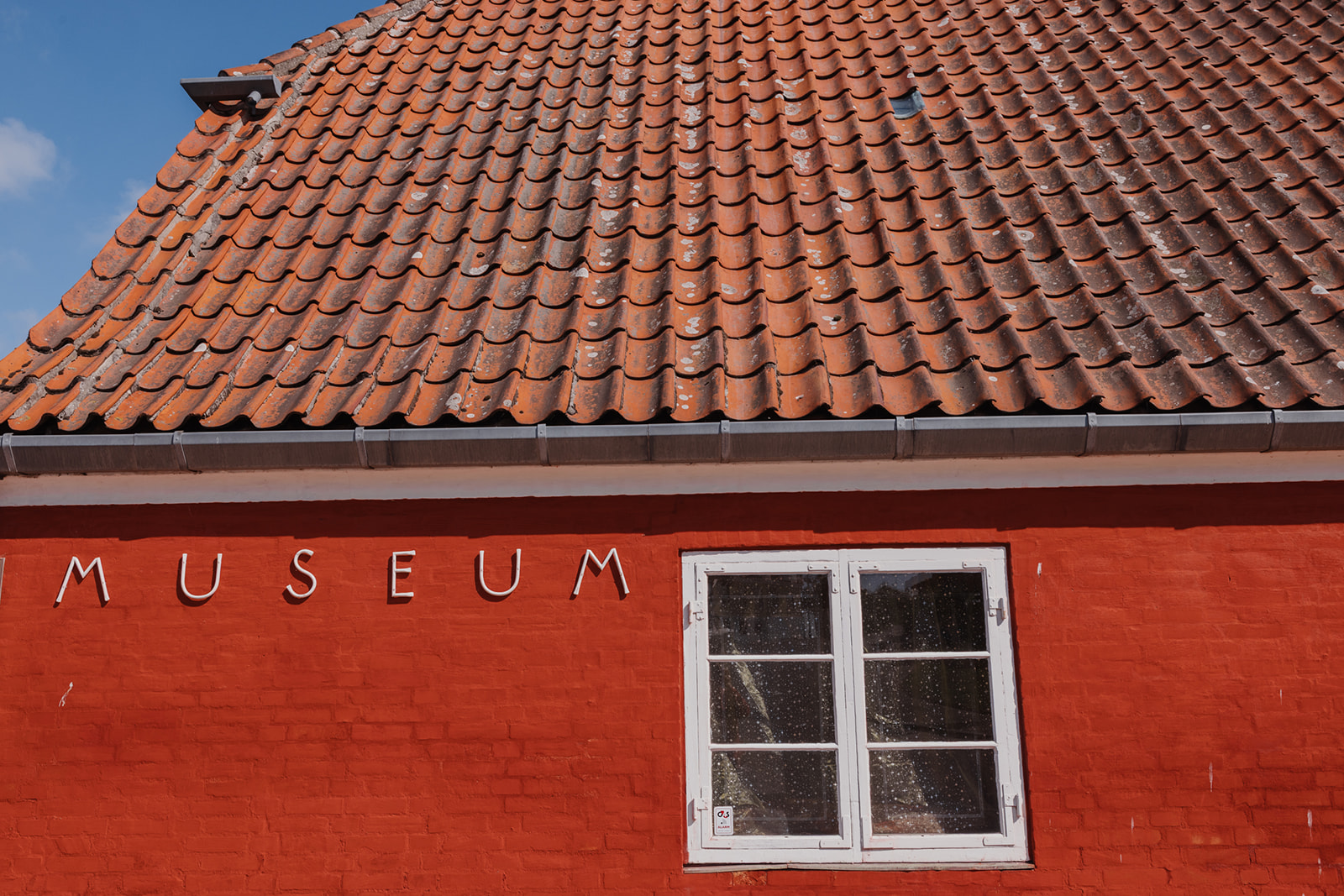
THE STORY BEHIND GUDHJEM MUSEUM
When The Bornholm Railways was liquidated in 1968, artists Axel Munch and his wife Esther, together with Paul Høm and his wife, the ceramic artist Lisbeth Munch-Petersen, took the initiative to try to prevent the station building from being converted to a tourist facility.
They recognised that the building had remained largely untouched since it was constructed and that they were looking at a unique building worth preserving. They tried to persuade the parish council to purchase the building “so that it would at least be protected from the degradation it would be to turn it into a cafeteria, storage facility or something else completely unrelated to the building.”
The original idea was not to turn the building into an exhibition space, but rather into an archive and storage facility for everything that could tell the story of the Gudhjem area. A fairly extensive collection of objects was already stored in the attic of the temperance hotel.
As so often before – and afterwards – everything eventually came down to money. In short, the initiators succeeded in buying the building in 1969 for DKK 135,000, without a penny in their pockets, but by personally guaranteeing a large part of the purchase price.
The movable property – the furnishings, the long bench from the station building and other items – was sold at a separate auction. The association used its small capital of just under DKK 10,000 to purchase these objects, which had originally been designed specifically for the building.
In connection with the purchase, there was also a wish to reserve the nearby engine sheds and other railway buildings for exhibition purposes. Once again, however, financial constraints stood in the way. The association had already taken on a great deal.
For several years after the station became a museum in 1969, the idea of a dedicated exhibition building remained alive. Numerous attempts were made to obtain foundation funding for such a building, but in 1975 it finally became clear that it was not possible to raise the necessary funds for such a project at that time.
In 1986, an inheritance from Sophus Phil breathed new life into the old plans for a building dedicated to art exhibitions. Two architects were invited to submit proposals, and the choice fell on a project designed by architect Niels Frithjof Truelsen of Fåborg, who was well known for his museum architecture, including the Fåborg Museum and the Asger Jorn Museum in Silkeborg.
Funding for the project was secured, and on 11 May 1990 the building was inaugurated. The museum also received substantial donations in the form of works of art. The following year, the project was completed with a new main entrance and visitor facilities in the old station building.
The next remaining wish was for a storage building for exhibition objects and props. On 19 October 2001, this final part of the museum complex was inaugurated.
Here too, Niels Frithjof Truelsen was responsible for the building. Its architecture was carefully designed to complement and draw inspiration from the architecture of the other station buildings along the Almindingen–Gudhjem railway.
Gudhjem, February 2012. Mogens Lau