



Nature Path
Natural woodland and historical sites
Start at the Gudhjemvej car park. Walk up to Duebakken, passing Kaffeslottet, built in 1912 by coffee merchant Sahl. The building materials came from the former main railway station in Copenhagen.
Continue along Gråmyrvej. On the opposite side of the valley you can see a red-rendered house where the artist Sigurd Vasegaard and ceramicist Gertrud Vasegaard lived.
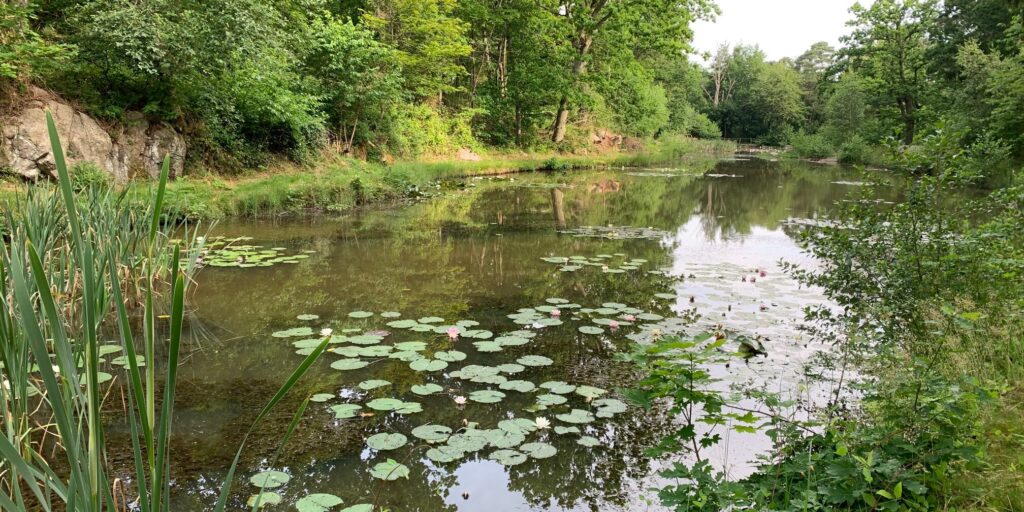
Take the path up into Gudhjem Plantage, a natural woodland, and continue to Lake Gråmyr.
The bog was enlarged when clay was needed for Gudhjem Harbour. At the edge of the lake stands a standing stone that was once part of “Varmeklippen”, a rock formation that was originally 40 metres long. This was where the underground folk danced.
Part of the rock was blasted away for use in Gudhjem Harbour after the storm surge of 1872. The underground folk supposedly took revenge with the storm surge of 1904 – or so the story goes.
From here you can choose between two routes:
One leads east via Bokul. Before Helligdomsvej is “Træskodammen”, where farmers cleaned their wooden clogs before continuing into town or to the church.
The tall flagpole stands on Bokul Mountain. In the 1930s, painters were everywhere. Here they stood at their easels in their favourite spots.
The Oluf Høst Path leads steeply down to Løkkegade. At the bottom, towards the water, is the Høst Museum in the former home of Oluf and Hedvig Høst.
If the Høst Path is too steep or slippery, you can get down into town via Bokulvej and Holkavej and follow it to the harbour.
The second route from the lake leads up past the field with the farm Bognemark, one of Oluf Høst’s favourite subjects. After crossing the main road, look for the sign “Sti mod Gudhjem by” at the top of Serpentinervejen.
The path leads to Hestestenene and its dramatic story. A young couple are said to have driven over the cliff in a horse-drawn carriage, straight to their deaths. Whether the story is true has never been proven, but the view is certainly worth the trip.
The rocky area known as Røverborgen was used as a film location for “Sicilianerrøverens Bryllup” in 1917.
In 1904, Prinsessehaven was laid out by Stephan Nyeland and named after Princess Marie, who gave him a white bulldog in return. Serpentinervejen dates from 1967.
A staircase leads from Serpentinervejen down to the former “bredbaner”, where fishermen dried their nets. In summer you may see the rare yellow flower Oriental Tansy.
Gudhjem’s second harbour is Nørresand (Norresân). It is used when there are strong easterly winds.