



Cliff Path
The route with the magnificent views
Start at the Melstedvej car park. Leave the car park on the side opposite the entrance and follow Inge Madsens Sti, opposite the reception at Gudhjem Feriepark.
When you emerge from the path onto Melsted Langgade, you will see a red, thatched house that was once the studio of artist Jais Nielsen. Edward Weie and Olaf Rude lived and worked here for periods, with a view of the so-called Sølvklippen, with its veins of pure white quartz.
Next to it is the protected area known as “Sletten”, now a campsite.
The Tulaknajlstien (Cliff Path) starts at the entrance to the campsite. Store Jernkås, a pebble beach, lies in the bay.
Continue along the road to a small fenced area, which you pass on the left. The fenced area is an Iron Age burial site.
Continue straight ahead. On the left there was once a small quarry where fishermen earned a little extra money by producing crushed stone.
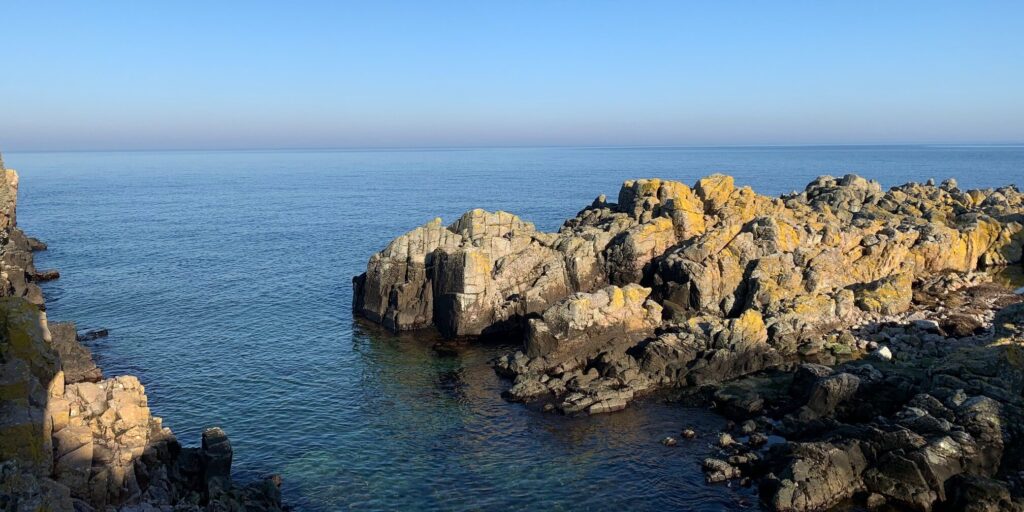
The path winds beautifully along the very edge of the cliffs. After a blackthorn thicket, you can turn right and enjoy the view towards Svaneke and the magnificent Randkløve cliffs below.
According to legend, Tulaknajl was named after a Swedish troll woman called Tula, who threw stones at the churches of Gudhjem and Østerlars. Some of them landed in the sea and became underwater skerries.
Further ahead, on the left, you will see a sign reading “Møllers trappe”. In the opposite direction is “Møllers badekar” at the water’s edge, where you can swim when there is no onshore wind.
After Åborenden, there is a white house with studio windows on the left. It was built by the painter Niels Lergaard.
You have now reached Grevens Dal, from where soil was shipped to Christiansø for the creation of gardens when the fortress was built in 1684.
In front of you is the rock Åsen, with a fine view over the harbour. To the right you may see some swimmers. They are swimming in “Pænjakisten” (the money chest), which is deep enough for diving.